SUPOR™ Ear Reconstruction
The purpose of outer ear reconstruction is the restoration of craniofacial balance by creating an aesthetically pleasing, symmetric and long-lasting pinna. Ear reconstruction should be considered an aesthetic procedure and its results should be held to the same critical standards as other cosmetic surgeries.
After having performed multiple techniques for ear reconstructions, Dr. Tahiri decided to only perform the PPE/SUPOR™ Ear Reconstruction; technique that was popularized by his colleague and founder of the surgery, Dr. John Reinisch. Dr. Tahiri has an extensive experience in PPE/SUPOR™ ear reconstruction and is considered one of the world experts in ear reconstruction.
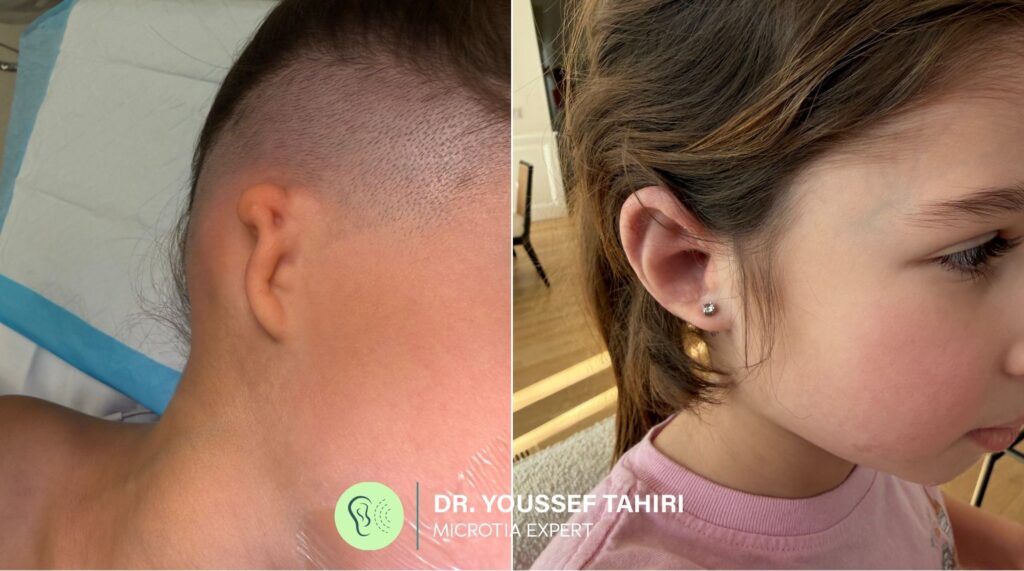
Comparing your options
Traditional Rib Cartilage
SUPOR™ One-Stage
Rationale
The traditional method of ear reconstruction has utilized an ear framework made from rib cartilage. Refinements of the cartilage procedure over the years have reduced the number of needed surgical stages. However, the amount of required harvested cartilage has increased, pushing back the age of reconstruction until 10 years of age or older. Reconstruction at an older age, and its usual multiple stages, have made microtia reconstruction with autologous cartilage a more arduous physical and psychological endeavor for both children and their parents. If the final cosmetic result of the constructed ear is not ideal, the entire reconstructive journey can be disappointing.
The use of an PPE/SUPOR™ framework covered by a thin temporo-parietal fascia flap offers several advantages over the traditional method of cartilage reconstruction. Since ears reach 85% of adult size by 3.5 years, ear reconstruction can be performed at a younger age since the need for sufficient costal cartilage is not a factor. Other advantages of a fascia covered alloplastic framework over the traditional rib cartilage technique include minimal patient discomfort, single outpatient procedure, and better ear definition and projection.
Indications and Contra-Indications
Candidates for PPE/SUPOR™ implant reconstruction include patients with congenital microtia, as well as patients with a traumatic loss of their ear or a prior unsatisfactory ear reconstruction. Patients must have either an intact superficial temporal artery supplying the superficial temporal-parietal fascia or a patent occipital artery supplying the occipital parietal fascia. Free fascia flaps with a radial forearm fascia or a free contralateral TPF flap are possible in the rare case, in which no local arterial fascia flaps are available.
Conditions that would be contraindications for traditional rib reconstruction (low hair line, mastoid scaring, or a previous atresia repair) are not contraindications for PPE/SUPOR™ ear reconstruction if the entire implant can be covered with well-vascularized fascia.
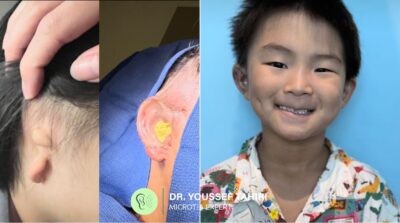
Procedure
The PPE/SUPOR™ ear reconstruction is a very complex procedure that only few surgeons in the world can perform while obtaining a good outcome. The procedure is performed as an outpatient procedure.
While the harvest and assembly of the framework is the most challenging and time-consuming component of the rib ear reconstruction procedure, the most critical component of the PPE/SUPOR™ reconstruction is the soft tissue coverage of the framework. If a healthy fascia flap covers the implant without tension, an PPE/SUPOR™ reconstruction can be done with minimal complications. In addition, the ability to complete the procedure in a single, outpatient procedure before starting school is a very appealing feature of PPE/SUPOR™ ear reconstruction.
The fascia we typically harvest is the superficial temporal fascia flap that is located under the scalp. This fascia is harvested using the same incision we use for the ear reconstruction. Since we have a lot of experience harvesting this flap, we do not need to perform a scalp incision, obviating scalp alopecia. This requires additional time and effort using a headlamp, high-power loupe magnification, and custom retractors and varying lengths and configurations of instruments.
Post-Operative Care & Instructions
The first post-operative appointment occurs at post-op day #2 or #3. The absorptive dressing is removed during this appointment. If fluid is noticed beneath the scalp at that time, it can be easily drained percutaneously with a butterfly needle. The silicone ear splint is left in place for a total of two weeks post-operatively. During that period, the head should be kept dry and patient should not sleep on the side of surgery to avoid pressure on the reconstructed ear.
For young children, parents should sleep with the child to make sure they do not inadvertently turn and sleep on the operated side.
At two weeks post-operatively, the silicone ear mold is removed and the ear and head are washed with shampoo in the office. Parents are shown how to wash it gently with their fingers on a daily fashion. A new silicone ear mold is made for the patient to use at night for the following four months. A light coating of ointment is applied on the ear before applying the ear mold for the next week.
The third post-operative visit occurs after three weeks. Washing can now be done with a gauze pad to encourage removal of the dissolving chromic sutures. Parents are taught how to make the silicone ear mold, which will be worn every night for the following four months (parents are provided with the silicone mold packets). This helps to protect the ear, but more importantly, it helps to maintain the projection of the ear.
Complications
As with any surgical procedure, PPE ear reconstruction carries a small risk of complications, and it is important that families feel fully informed before making a decision. The most common concerns include temporary swelling, bruising, and minor wound healing issues in the days following surgery. In rare cases, exposure of the implant framework through the skin may occur, which may require additional intervention. Infection, while uncommon, is possible and is managed promptly with antibiotics or, in very rare instances, further surgical care. Asymmetry or the need for minor revision surgery to refine the shape or projection of the ear can occasionally arise, and Dr. Tahiri addresses these with the same level of care and precision as the original procedure. Serious complications are rare, and the overwhelming majority of patients and families report outcomes that far exceed their expectations. Fractures used to a complication we saw with older generation implants. We have not seen any fractures with our new generation SUPOR™ implants.
Dr. Tahiri takes an individualized approach with every patient, taking the time to discuss all potential risks in detail during your consultation so that you can move forward feeling confident and well-prepared.
Considering this procedure?
Families from 65+ countries trust Dr. Tahiri. Speak with our team about candidacy.
Book Now