Prominent Ears
Ears that stick out more than 2 cm from the side of the head are considered to be prominent or protruding. In most people this is due to lack of formation of the antihelical fold, which makes the helix stick out. Additionally, most people with protruding ears have a deep concha, which pushes the entire ear away from the side of the head.
On this page
Definition
Prominent ears are ears that protrude more than 20 mm and at an angle greater than 35 degrees from the scalp.
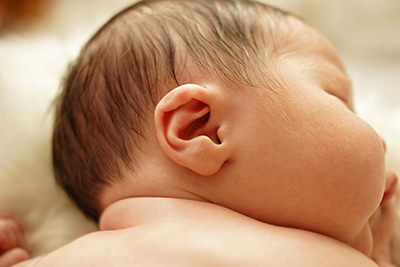
Etiology
– Matsuo theorizes that the high level of circulating maternal estrogens in neonates makes the auricular cartilage soft and malleable
– Force of a weak posterior auricular muscle can be overpowered by forces in the intrinsic muscles of the anterior surface of the ear
– As estrogen levels diminish, the cartilage acquires more elastic resilience, a more retentive memory, and the shape of the cartilage is altered permanently
Pathophysiology
Most common causes of protrusion of the external ear are:
1) An underdeveloped or flat antihelix
2) An overdeveloped deep concha
3) A combination of both of these features
Contributing features that accentuate auricular protrusion are:
1) Prominence of the mastoid process
2) Protrusion of the lower auricular pole (cauda helicis, lobule, cavum concha)
3) A prominent, tipped upper auricular pole
Frequency
– 5% of Caucasians population
– Positive family history in 59% of affected individuals
-Transmission is in an autosomal dominant pattern with variable penetrance
Indications for surgery
– Prominent ears typically do not affect a child’s self-image until they are older than 5 or 6 years, and surgery is best performed prior to this age
– Adults may present with prominent ears not corrected or incompletely corrected in childhood
Contraindications
– Contraindicated in any patient with unrealistic expectations
– Patients unable or unwilling to cooperate with postoperative care are not candidates for surgery
Goals of treatment
When treating prominent ears, your surgeon should aim at correcting the protrusion while giving a natural look and avoiding a plastered down look. This includes creating a smooth antihelical fold instead of a sharp one.
Nonsurgical
Protruding ears can often be corrected without surgery if your child comes to us early enough, while their ears are still soft. Ear molding uses a combination of a commercially available ear molding system and orthodontic molding materials. Commencement of treatment as early as possible (first 2-3 weeks) is a key to success. The time needed for correction varies widely from a few days to a number of months.
Surgical Technique
For ears that are already protruding and too stiff for molding, surgical correction is an option. It may be preferable to wait until about age 6, when ears are almost fully grown. This coincides with the age when children typically begin to receive teasing from their peers, which provides additional incentive for them to undergo surgery. The operation is usually performed through an incision behind the ears. A combination of cartilage scoring and suturing is used to create an antihelical fold. Additional sutures on the back of the conchal cartilage bring the entire ear closer to the side of the head. Although a general anesthetic is needed, the operation is done on an outpatient basis.
Parents should be aware that insurance companies consider otoplasty to be a cosmetic operation, and therefore they will often not cover the fees associated with this procedure.