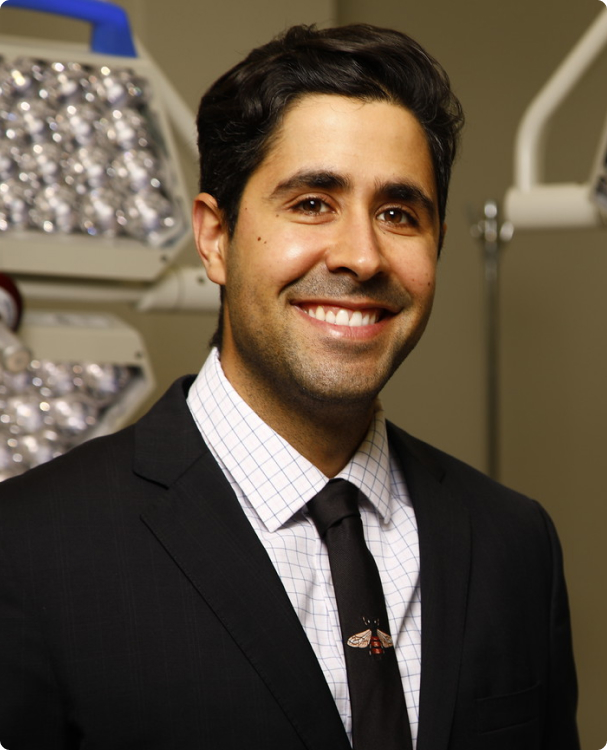
If you’re living with a visible skull defect after trauma or brain surgery, you don’t have to stay that way. Fellowship-trained craniofacial surgeon, Dr. Youssef Tahiri, uses advanced 3D-planned cranioplasty and custom implant technology to restore bone protection, rebuild a natural head shape, and give you your confidence back.
A skull defect or contour abnormality isn’t just a cosmetic concern. It changes how you feel in public, how safe your head feels, and how you see yourself every day. Dr. Youssef Tahiri understands that — and has dedicated his surgical practice to solving it.
Fellowship-trained in craniofacial surgery with deep expertise in neurosurgical anatomy, Dr. Tahiri performs advanced cranioplasty and custom skull reconstruction using the latest 3D imaging, virtual simulation, and patient-specific implant technology.
Every repair is planned digitally before a single incision is made — for results that are precise, predictable, and permanent.
Schedule Your ConsultationCranioplasty repairs and reshapes your skull when bone is missing, dented, uneven, or excessively prominent. It is not about changing who you are — it is about restoring natural proportions so your head looks and feels normal again.
Restoring volume where the skull is missing or flat — including temporal hollowing, post-craniectomy defects, and parietal flattening. A custom PEEK or titanium implant is fitted and secured with precision.
Reshaping areas of excessive bone prominence — frontal bossing, occipital projection, and asymmetric skull contours that affect facial balance. Bone is carefully reduced while preserving thickness and symmetry.
Correcting results from prior surgeries that failed, shifted, or left contour problems. Dr. Tahiri specializes in complex revision cases — including failed implant reconstructions and trauma cases with irregular bone loss.
“You don’t have to keep living with a visible skull defect. With the right planning, the right technology, and the right surgeon — most patients never look like they had surgery at all.” Dr. Youssef Tahiri, Craniofacial Surgeon
Fellowship-Trained Craniofacial Surgeon
Extra, specialized training beyond standard plastic surgery — specifically for complex cranial reconstruction and aesthetic skull contouring.
Deep Neurosurgical Anatomy Knowledge
Working close to the brain and major vessels demands expertise most surgeons don’t have. Safety and restoration work together in every case.
Complex Reconstruction Expertise
Dr. Tahiri’s experience includes trauma-related skull fractures, large defects after decompressive craniectomy, failed implant reconstructions, and revision cranioplasty. If your prior surgery went wrong, this is the background you want.
Advanced 3D Planning & Virtual Simulation
Every case begins with high-resolution 3D CT imaging, CT-based 3D modeling, and virtual surgical simulation. Your repair is designed and tested digitally before a single incision is made.
Custom, Permanent Implants
Custom-designed implants are built from your CT scan using modern materials including PEEK (polyetheretherketone), porous polyethylene, or titanium. Precision titanium fixation locks everything in place for long-term durability.
Meticulous Technique for Natural Results
Hidden hairline incisions and subperiosteal dissection is used to protect underlying structures. He achieves a natural, undetectable result by prioritizing advanced cranial contouring, symmetry, and ideal proportions. The goal: no one can tell.
From first consultation to final result — a clear, supported process at every stage.
Consultation
Dr. Tahiri begins with a detailed review of your history and a thorough examination of your head and scalp. This leads to an honest discussion of what is possible, ensuring there is no pressure and no surprises.
3D CT Planning
Leveraging high-resolution CT imaging and virtual surgical simulation, your custom implant is digitally designed and thoroughly tested before your surgery.
Surgery
The procedure is performed under general anesthesia. It involves making incisions concealed within the hairline, followed by subperiosteal dissection. A custom-designed implant is then positioned and secured using titanium fixation, and the procedure concludes with a layered closure.
Recovery & Results
Expect mild swelling to last for 2–3 weeks. The final contour will become visible as the swelling subsides. Light activities can typically be resumed within 1–2 weeks. Hair regrowth over the incision site will occur.
A skull defect is not just cosmetic. It affects how safe your head feels, how you photograph, and how comfortable you are in public. You are not being vain.
No pressure. No surprises. Just an honest conversation about what is possible for your skull and your life.
You will leave understanding exactly what can be improved, how your brain will be protected, and how long recovery will take.
Schedule Your Consultation
Every cranial surgery carries risk. We believe you deserve to know exactly what those risks are before you decide—not after. Potential risks include:
“Dr. Tahiri, our plastic surgeon, stands out to us and will always have a place in my family’s heart. I truly believe he saved our son’s life twice. He truly cares about his job and the patients that he treats. He has made surprise visits to our room, and has called me after work hours and on weekends to give us test results that we were so desperately waiting for.”
“[Dr. Tahiri] jumped right in, getting involved with our family and making sure that Jack had a care plan that worked for all of us. He is amazing with Jack and our older son, and he always sits and answers as many questions as we might have. Dr. Tahiri was the first person to come into our pre-op room on the day of the 3rd and biggest surgery, and he made us feel at ease right away. My husband and I love that he is so passionate about his work. Dr. Tahiri takes great pride in creating good looking Big Ol’ Heads with lots of room for brain growth!”
“Thank you from the bottom of our hearts for the care, dedication, and compassion you showed our daughter. Your work has truly created a turning point in her life, and we will always be greatful for the positive change you made. You gave her not only treatment, but confidence and hope for the future.”
If you are living with a skull defect, contour abnormality, or asymmetry after trauma or surgery — you have already been through enough. You do not have to keep living with it.
Dr. Tahiri develops individualized treatment plans using advanced imaging and 3D surgical planning to restore cranial structure and a natural head shape. The consultation is where it all starts: understanding your anatomy, your goals, and building a plan around you.
Phone